Short-beaked Echidna: How a Spiny Mammal Survives Bushfire
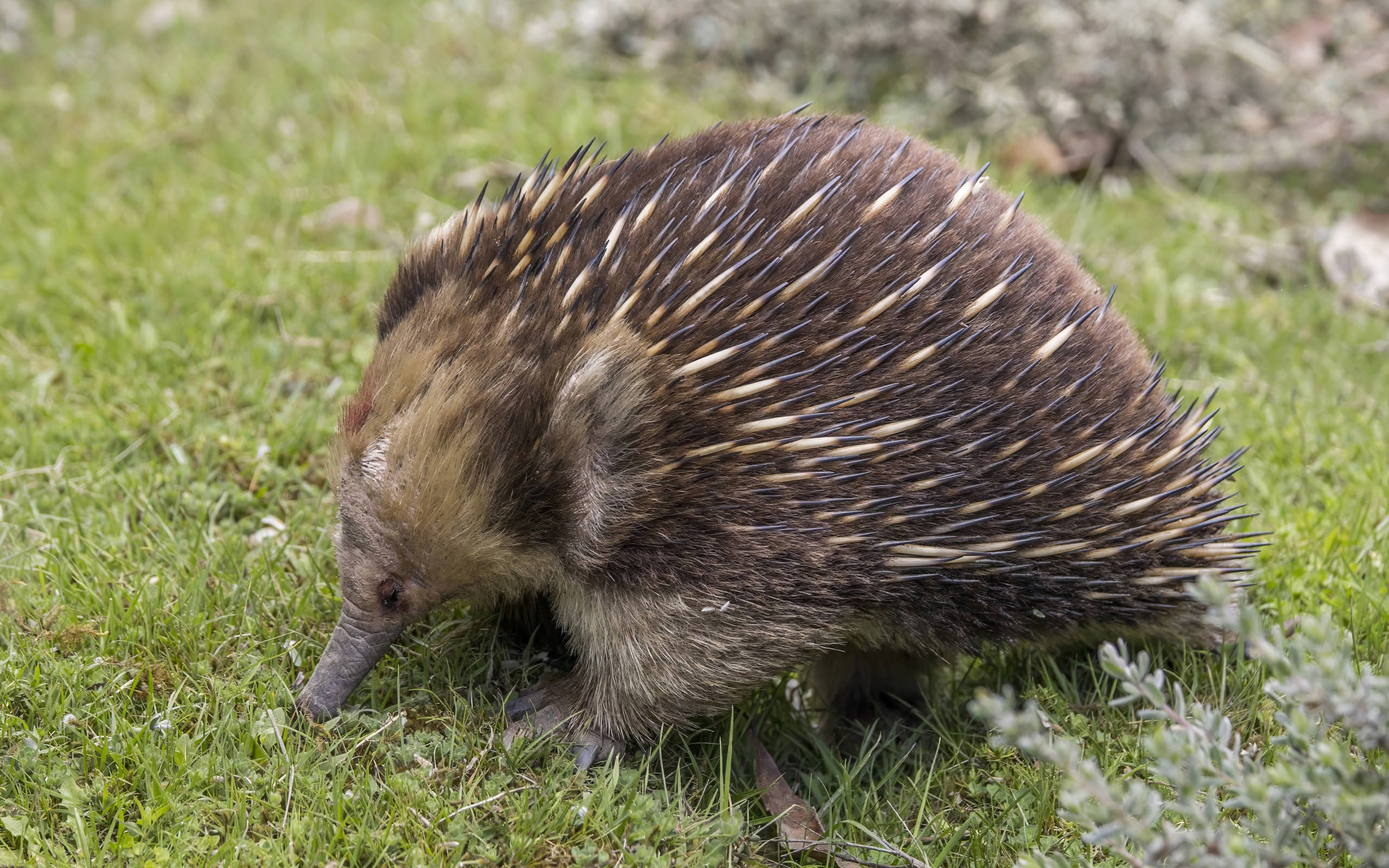
Species deep dive · short beaked echidna
How do echidnas survive bushfires? They hide, and then they switch off. As a fire passes, a short-beaked echidna shelters in a burrow, under rocks or in a hollow log. In the days and weeks afterwards it stays put, lets its body temperature drop and spends long stretches in torpor, saving energy until the burnt bush can feed it again (Nowack, Cooper & Geiser 2016). It isn't a perfect strategy, and a hollow log can turn into a trap. But it works often enough that echidnas sometimes turn up alive in places people had given up on.
One of those places is in the news today.
The island where the echidnas came back
Lungtalanana, also called Clarke Island, is an Aboriginal-owned island of about 8,230 hectares in Bass Strait, off Tasmania's north-east coast. In 2014 a bushfire burnt 98% of its vegetation (ABC News). For years, nobody knew whether any echidnas had made it.
In 2023 a trail camera caught two images of an echidna, months apart. They were the first record of the species on the island in decades, and WWF-Australia, which supports the island's Aboriginal-led restoration project, called it "Australia's loneliest echidna" (ABC News). Cameras then picked up an echidna in October 2025 and January 2026, more than 4 km from the first sighting. On 19 September 2026 one walked into a cage set for feral cats, the first time a pakana ranger had met one face to face. More camera records followed near the airstrip in August and at Rebecca Bay in the south in October, about 8 km away (WWF-Australia).
University of Tasmania echidna researcher Stewart Nicol pointed out that echidnas in the Tasmanian midlands do 90% of their moving within about 60 hectares (males) or 35 hectares (females), so these are very unlikely to be one wandering animal (WWF-Australia). He told the ABC he would be surprised if there were fewer than a dozen on the island, and that there could be 20 or 30 or more (ABC News). In the local palawa kani language, the echidna is trimanya.
Inside the fire study
The best look at what an echidna actually does in a fire comes from a planned burn. On 21 April 2015, land managers carried out a prescribed burn over 227 hectares of Dryandra Woodland, southeast of Perth in Western Australia. Julia Nowack, Christine Cooper and Fritz Geiser had already fitted ten wild echidnas with temperature loggers and tracking tags, five living in or next to the burn area and five in unburnt woodland nearby (Nowack et al. 2016).
Here's what happened:
- Four of the five echidnas at the fire site survived.
- They lay low. The night after the fire, the burnt-area echidnas were active for about 3 hours on average, compared with nearly 8 hours for the unburnt group. All of them stayed inactive through the following day or days.
- They cooled down. Three of the four survivors went into multiday torpor straight after the fire, lasting from about 51 to 123 hours. Through the study, echidna body temperatures dropped as low as 11.6°C during torpor.
- They stayed home. For weeks after the burn, none of them left its burnt home range. Instead they kept their body temperature lower and their activity down, which the researchers link to there being less to eat (Nowack et al. 2016).
Torpor is a controlled drop in metabolism and body temperature, like a short version of hibernation. For an animal that eats ants and termites dug from soil and logs, it buys time: an echidna that barely burns any fuel doesn't need to forage in a blackened landscape with no cover.
Where hiding goes wrong
Shelter only works if the shelter doesn't burn. The one tagged echidna that died at Dryandra was resting in a log that caught fire. A second tagged echidna in the same log woke from torpor, left during the fire and reached another shelter about 160 metres away. Two untagged echidnas were also found dead in the remains of burnt logs (Nowack et al. 2016).
That cuts both ways. Fallen logs, stumps and leaf litter are important echidna habitat, and they also hold the ants and termites echidnas eat (ABC News). In a fire, the same logs can burn through.
An old mammal trick
The researchers weren't only interested in echidnas. A long-standing idea holds that when the asteroid impact about 66 million years ago set off huge fires, the mammals that survived were the ones able to hide and drop into torpor, waiting out the aftermath without eating. Echidnas are egg-laying mammals with many ancestral traits, so they make a good living test of that idea. The study's conclusion is that torpor helps a mammal outlast a fire and the scorched landscape afterwards, and that it may have mattered for mammal survival back then too (Nowack et al. 2016).
Echidnas lean on the same low-energy lifestyle all year. They have notably low metabolic rates, and in colder places they hibernate (Animal Diversity Web). Their closest living relative is the platypus, the only other kind of monotreme. Our platypus piece covers how that cousin hunts with electricity.
How the echidna plays in Wilder
The Short-beaked Echidna (Tachyglossus aculeatus) is an Uncommon Mammalia card in the Forest element. It costs just 2 Energy, with Attack 1 and Health 4, and it has Thorns and Resilient. Like the real animal, it isn't there to win fights. It's there to be very hard to get rid of, and anything that attacks it gets pricked. Flavour text: "It digs straight down until only a back full of spines is left to grab."
Wilder is a free browser collectible card game about real animals, and you can play it free in your browser with no signup.
Photo credit
Hero photograph: Charles J. Sharp, "Short-beaked echidna (Tachyglossus aculeatus setosus) Scottsdale" (a Tasmanian short-beaked echidna foraging near Scottsdale, Tasmania), Wikimedia Commons, CC BY-SA 4.0. Cropped for the Field Journal hero.

Questions people ask
Do echidnas hibernate?
Yes, in many places. Short-beaked echidnas can hibernate from early autumn to late spring, cooling to 8–10°C in torpor and waking up now and then, often under leaf litter or grass tussocks. The timing depends on the subspecies, location, sex and whether a female is breeding (Animal Diversity Web).
How do echidnas cope with hot weather?
With snot bubbles, among other tricks. Echidnas can't sweat, pant or lick to cool off, so on hot days they blow mucus bubbles that wet the tip of the beak, and evaporation cools the blood underneath. They also raise their spines to let heat escape and lose heat through their spineless belly and legs (Curtin University; Cooper & Withers 2023).
What should I do if I find an echidna in my garden?
Usually nothing. Leave it alone and keep dogs away. Wildlife rescuers in Adelaide say echidnas wander through suburbs on purpose to reach food and water, and that well-meaning people shouldn't move them (ABC News). Contact a local wildlife rescue group if it's injured.
What animals eat echidnas?
Not many. Feral cats, pigs, dingoes and goannas take echidnas occasionally, mostly young ones in burrows and subadults, and adults escape by digging in until only their spines show (Animal Diversity Web). Cars, dogs and foxes also kill echidnas (Australian Museum).
Sources
- Nowack, Cooper & Geiser (2016) Cool echidnas survive the fire, Proceedings of the Royal Society B
- ABC News (5 Nov 2026): Echidna sightings on Aboriginal-owned Lungtalanana/Clarke Island excite after extensive bushfires
- WWF-Australia media release (5 Nov 2026): Mystery solved, this is not Australia's loneliest echidna
- Animal Diversity Web: Tachyglossus aculeatus
- Australian Museum: Short-beaked Echidna
- Cooper & Withers (2023) Postural, pilo-erective and evaporative thermal windows of the short-beaked echidna, Biology Letters
- Curtin University: Study finds blowing bubbles among echidna's tricks to beat the heat
- ABC News (24 Oct 2026): Adelaide echidnas on the prowl as breeding season stretches late