Saw-Scaled Viper: Is It Really the Deadliest Snake in the World?
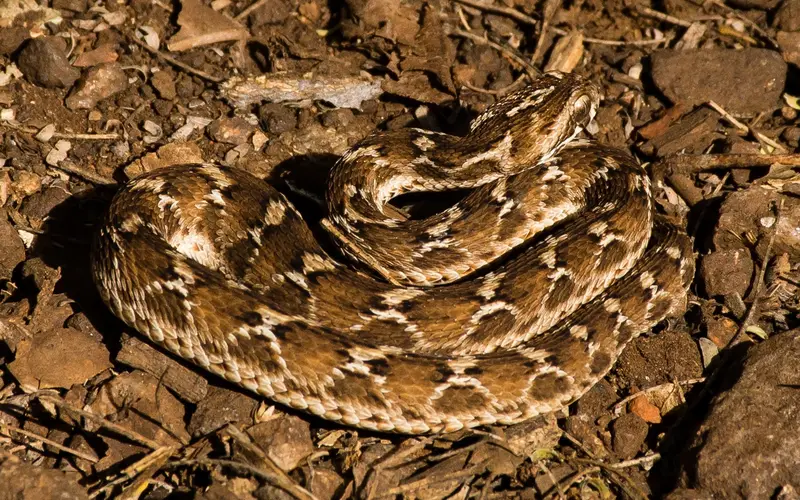
The "deadliest snake" title belongs to the saw-scaled viper's whole genus, Echis. The Indian species bites far fewer people than Russell's viper.
Play Saw Scaled Viper in Wilder, free in your browser
Species deep dive · saw scaled viper Play this card
*Not as a single species, no. If any snake deserves the "deadliest snake in the world" title, it's the saw-scaled viper's whole genus, Echis, the saw-scaled and carpet vipers, which together carry a snakebite burden "exceeding that of almost any other snake genus globally" (Rogalski et al. 2017). The species most people mean, the Indian saw-scaled viper (Echis carinatus), is dangerous, but in India's large snakebite studies it made up only about 2% of bites where the snake was identified, far behind Russell's viper at 43% (Suraweera et al. 2020). Most of the Echis* death toll comes from its relatives in Africa.
That's why it sits sixth, not first, in our Most Dangerous Snakes, Ranked. Here's where the famous claim comes from, and what it gets right.
One name, many snakes
For a long time "Echis carinatus" was used for saw-scaled vipers right across their range. A 1988 account by the zoologist J. L. Cloudsley-Thompson still describes E. carinatus as a desert species "ranging from the Sahara southwards into equatorial Africa and eastwards through central Asia to India and Sri Lanka" (Cloudsley-Thompson 1988).
Today those snakes are split into several species. Echis carinatus itself lives in South Asia, Iran, Central Asia and parts of Arabia (Reptile Database), while the African carpet vipers are other species, and in 2018 even the West African carpet viper was split in two (Reptile Database). So when an old book or a viral list says "the saw-scaled viper kills more people than any other snake", it usually means the whole group, African species included. Moving the record to the Indian species alone doesn't hold up.
What the numbers say in India
India is the best place to test the claim, because it has roughly half of the world's snakebite deaths and the best large-scale data (Suraweera et al. 2020). In the Indian studies reviewed by Suraweera and colleagues, the identified bites broke down like this: Russell's viper 43%, kraits 18%, cobras 12%, hump-nosed viper 4% and saw-scaled viper about 2%, with about a fifth of bites by an unknown snake (Suraweera et al. 2020).
That doesn't make it harmless. Those studies cover only part of the country, and the saw-scaled viper is a snake of dry, open country, so its share is likely bigger in drier regions than the average suggests. In the Thar Desert of Rajasthan, doctors in Bikaner described 12 people bitten by the northern form (E. sochureki, usually treated as a subspecies of E. carinatus, though some experts keep it as a separate species; IUCN). All 12 had blood that would not clot, 7 had bleeding, and one was left partly paralysed by a bleed in the brain, though all survived (Kochar et al. 2007). It is also one of the "Big Four" snakes that India's antivenom is made against (Suraweera et al. 2020).
Where Echis really is the top killer
In the savannas of West Africa, carpet vipers cause the majority of snakebite deaths (Edge et al. 2025). At the snakebite hospital in Kaltungo, north-eastern Nigeria, 79% of 1,022 patients treated in the first half of 2024 had been bitten by a carpet viper (Hamman et al. 2025). WHO calls the Echis vipers "a major cause of snakebite envenoming" across Africa, the Middle East and South Asia (WHO). That's the real story behind the record, and it's why the West African carpet viper ranks second in our list. Read West African Carpet Viper: Why a Small Snake Kills So Many People.
A small snake that warns before it bites
What the whole genus shares is a famous warning. When disturbed, a saw-scaled viper puffs up its body, pulls itself into open horseshoe-shaped coils and rubs the angled, saw-toothed scales on its sides against each other. Cloudsley-Thompson described the sound as "like violently boiling water", and it's thought this way of making noise saves water compared with hissing, which matters in a desert (Cloudsley-Thompson 1988). At the same moment the pale bands on its back, edged in black, stand out against the stretched skin, so a snake that was camouflaged a second ago becomes a warning sign. On smooth sand most of them also travel by sidewinding, which may help them avoid overheating because the loops of the body are lifted slightly off the hot ground (Cloudsley-Thompson 1988).
The species name fits too: carinatus is Latin for "keeled", like the keel of a ship, after those ridged scales (Reptile Database). The trouble is that the warning only helps if you hear it. Most bites by this species happen when someone steps on one at night in bare feet or sandals, or cuts grass by hand with a short sickle (Suraweera et al. 2020).
On the Wilder card
In Wilder the Saw-scaled Viper is an Uncommon Reptilia card in the Desert element. It costs 2 Energy, with Attack 2 and Health 1, and has three keywords: Venom, so combat damage it deals to another creature destroys it; Ambush, which lets it attack the turn it's played; and Basking, which gives it +1 Attack permanently at the end of your turn if it didn't attack (up to +2). With 1 Health it dies to almost anything, but a cheap snake that can strike right away and take down the biggest creature on the board is a fair picture of a viper you could easily step on in the dark. Its flavour text reads: "Small enough to miss at night. Most of its bites come from a bare foot that stepped on it."
For the snake that really does top the danger list, play Russell's Viper, and pair this one with its African cousin, the West African Carpet Viper. Wilder is a free browser collectible card game about real animals, and you can play it free in your browser with no signup.
Photo credit
Hero photograph: santhoshk, "Indian saw-scaled viper (Echis carinatus carinatus)" (photographed 5 December 2018), via iNaturalist on Wikimedia Commons, CC BY 4.0. Cropped for the Field Journal hero.

Play Saw Scaled Viper in Wilder, free in your browser
Questions people ask
Does the saw-scaled viper lay eggs?
No, it gives birth to live young. The Reptile Database describes Echis carinatus as ovoviviparous, meaning the eggs develop and hatch inside the mother, and notes that the other species in the genus lay eggs (Reptile Database). So the Indian saw-scaled viper is the odd one out among its carpet viper relatives.
Is the saw-scaled viper endangered?
No. The IUCN Red List rates Echis carinatus as Least Concern, with a stable population, because it is widespread, presumed to have a large population and occurs in protected areas. The assessors describe it as common throughout its range, from Iran and the Arabian Peninsula across Central and South Asia to Sri Lanka (IUCN).
Does antivenom work against saw-scaled viper bites?
It helps, but how well depends on which saw-scaled viper bit you. India's polyvalent antivenom is made with saw-scaled viper venom (Suraweera et al. 2020), yet in Rajasthan it was relatively ineffective at restoring clotting after bites by the northern form, though all 12 patients survived (Kochar et al. 2007). In lab tests, three of four antivenoms protected human plasma against only a narrow range of Echis species (Rogalski et al. 2017).
Are there harmless snakes that look like saw-scaled vipers?
Yes, several mimic them. Harmless egg-eating snakes (Dasypeltis) in Africa look like saw-scaled vipers and are said to make the same rasping display, and some back-fanged Boiga snakes and possibly a gecko in Pakistan are also thought to copy them (Cloudsley-Thompson 1988). Treat any small, rough-scaled snake in its range as dangerous.
Sources
- Rogalski A, Soerensen C, op den Brouw B, et al. (2017). Differential procoagulant effects of saw-scaled viper (Serpentes: Viperidae: Echis) snake venoms on human plasma and the narrow taxonomic ranges of antivenom efficacies. Toxicology Letters 280: 159-170
- Suraweera W, Warrell D, Whitaker R, et al. (2020). Trends in snakebite deaths in India from 2000 to 2019 in a nationally representative mortality study. eLife 9: e54076
- IUCN Red List: Echis carinatus (Ananjeva et al. 2021, assessed 2016)
- The Reptile Database: Echis carinatus
- The Reptile Database: Echis romani
- Cloudsley-Thompson JL (1988). The saw-scaled viper (Echis carinatus). British Herpetological Society Bulletin 24: 32-33
- Kochar DK, Tanwar PD, Norris RL, et al. (2007). Rediscovery of severe saw-scaled viper (Echis sochureki) envenoming in the Thar desert region of Rajasthan, India. Wilderness Environ Med 18: 75-85
- Edge et al. (2025). Preclinical evaluation of the neutralising efficacy of three antivenoms against the venoms of the recently taxonomically partitioned E. ocellatus and E. romani. PLoS Negl Trop Dis 19: e0013371
- Hamman et al. (2025). Using a machine learning approach to predict snakebite envenoming outcomes among patients attending the Snakebite Treatment and Research Hospital in Kaltungo, Nigeria. Tropical Medicine and Infectious Disease 10(4): 103
- World Health Organization: Snakebite envenoming, snakes gallery