Most Dangerous Snakes, Ranked: Russell's Viper Is No. 1
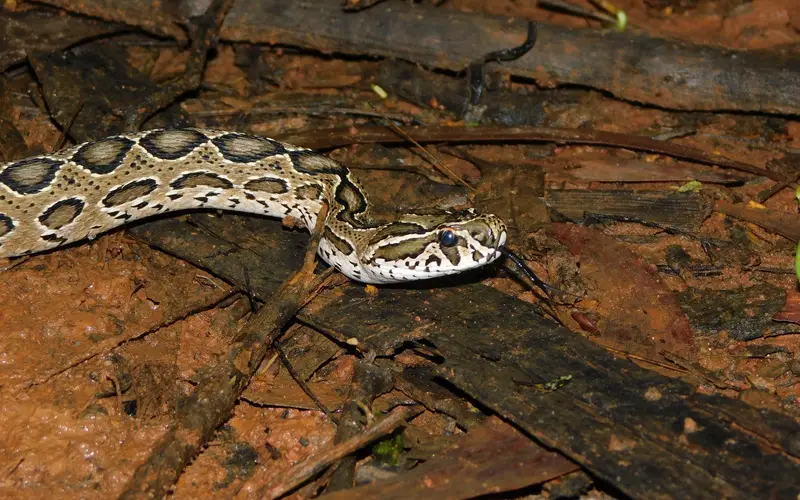
Russell's viper is the most dangerous snake to people, ahead of the carpet viper and common krait. The 10 snakes that bite and kill the most, ranked.
Play Russells Viper in Wilder, free in your browser
Showdown · russells viper Play this card, west african carpet viper Play this card, common krait Play this card, spectacled cobra Play this card, puff adder Play this card, saw scaled viper Play this card, terciopelo Play this card, black mamba Play this card, common lancehead Play this card, eastern brown snake Play this card
Russell's viper is the most dangerous snake to people. It's the snake named most often in Indian snakebite studies, at 43% of bites where the species was identified, in the country with roughly half of the world's snakebite deaths (Suraweera et al. 2020). The West African carpet viper is second and the common krait third. None of them has the world's strongest venom. They make the list because they live where people farm and sleep, so they bite people far more often than more famous snakes. Below are the 10 snakes that matter most, ranked by how much harm they actually do to people, with the caveats that come with them.
Keep the scale in mind. The World Health Organization (WHO) estimates that about 5.4 million people are bitten by snakes each year, 1.8 to 2.7 million of them are envenomed, and 81,410 to 137,880 die. Around three times as many are left with amputations or other permanent disabilities (WHO). India alone had an estimated 1.2 million snakebite deaths from 2000 to 2019, about 58,000 a year (Suraweera et al. 2020).
How we ranked them
This is not a venom table. Our October showdown ranked snakes by venom strength in lab mice, and the inland taipan won easily (Most Venomous Snakes: Inland Taipan, LD50 Rankings, and Why Deadliest Differs). This list ranks danger to people: how many people a snake bites and kills, and how badly its bite harms them, based on hospital and death studies from the places where most snakebite deaths happen.
There is no reliable global death count for each species. WHO doesn't publish one, and most bites are never identified to species, so nobody can honestly say "snake X kills Y people a year". We put the snakes that dominate snakebite in the worst-hit regions (South Asia and sub-Saharan Africa) at the top, then the snakes that dominate in Latin America and Australia. Within that, a snake that bites more people ranks above one that bites fewer, and a deadlier bite breaks close calls.
The most dangerous snakes, ranked
| Rank | Snake | Scientific name | Where it matters most | Key evidence | Venom mainly attacks | Wilder card |
|---|---|---|---|---|---|---|
| 1 | Russell's viper | Daboia russelii | South Asia | 43% of identified bites in India | Blood and kidneys | Russell's Viper |
| 2 | West African carpet viper | Echis ocellatus | West African savanna | Carpet vipers: at least 66% of bites in a north-eastern Nigeria study | Blood and tissue | West African Carpet Viper |
| 3 | Common krait | Bungarus caeruleus | South Asia | Kraits: 18% of identified bites in India | Nerves | Common Krait |
| 4 | Spectacled cobra | Naja naja | South Asia | Cobras: 12% of identified bites in India | Nerves and tissue | Spectacled Cobra |
| 5 | Puff adder | Bitis arietans | Sub-Saharan Africa, Arabia | Three quarters of 83 bites at a Zimbabwe hospital | Tissue and blood | Puff Adder |
| 6 | Saw-scaled viper | Echis carinatus | South Asia, Middle East | One of India's "Big Four" | Blood | Saw-scaled Viper |
| 7 | Terciopelo | Bothrops asper | Central America | Most of Central America's ~5,500 bites a year, and most deaths | Tissue and blood | Terciopelo |
| 8 | Black mamba | Dendroaspis polylepis | Eastern and southern Africa | 21 deaths in 75 confirmed bites in a South African survey | Nerves | Black Mamba |
| 9 | Common lancehead | Bothrops atrox | Amazon | Most snakebites in the Amazon | Blood and tissue | Common Lancehead |
| 10 | Eastern brown snake | Pseudonaja textilis | Eastern Australia | Brown snakes: 23 of Australia's 35 snakebite deaths, 2000–2016 | Blood | Eastern Brown Snake |
Sources for each row are in the sections below. "Kraits" and "cobras" in the Indian figures mean the whole group (Bungarus and Naja species), not only the species ranked here.
Read this before you trust the ranking
Most bites are never identified. In the Indian studies behind the 43% figure, 21% of bites were by an unknown snake, and the share of each species is a share of identified bites, not of deaths (Suraweera et al. 2020). The same researchers warn that painless night bites by kraits, ending in paralysis by morning, may not be recorded as snakebite at all, so kraits are probably undercounted (Suraweera et al. 2020).
Country totals are not species totals. You'll often see the figure of about 1,927 deaths a year linked to the carpet viper. That's the estimate of all snakebite deaths in Nigeria, the highest of 16 West African countries, not a carpet viper count (Habib et al. 2015). Carpet vipers cause many of those deaths, but nobody has measured exactly how many.
Names change. In 2018 the carpet vipers of Nigeria, Chad, Niger, northern Cameroon and the Central African Republic were split off as a separate species, Echis romani (Reptile Database), so some older "E. ocellatus" figures include snakes that now belong to E. romani. And "fer-de-lance" is used for more than one Latin American pit viper, so we use terciopelo for Bothrops asper (Gutiérrez 2014).
Treatment changes the death toll. The same bite that kills a farmer hours from a hospital is usually survived by someone who gets antivenom and breathing support quickly. WHO says most snakebite deaths and serious harm could be prevented with safe, effective antivenom that people can actually reach (WHO). That's a big reason Australia's number one snake is only number ten here.
1. Russell's viper
The Russell's viper tops the list because of where it lives. It hunts rats in India's farmland, it's active at night, and when someone comes close it tends to stay still and rely on its camouflage instead of moving away. Most bites happen when someone steps on one in the dark, or reaches into a crop by hand at harvest time (Suraweera et al. 2020). In Indian studies from 2000 to 2019 that identified the snake, it caused 43% of bites, more than any other species (Suraweera et al. 2020).
Its venom uses up the blood's clotting factors, so the blood stops clotting, and some survivors develop pituitary failure later on (Ministry of Health and Family Welfare 2017). Its eastern relative, the Siamese Russell's viper (Daboia siamensis), is now a separate species in South-East Asia, and WHO notes that in Myanmar, bites by the Siamese Russell's viper are a major cause of acute kidney injury needing dialysis (WHO). The full story is in Russell's Viper: Why It Bites More People in India Than Any Other Snake.
2. West African carpet viper
The West African carpet viper is rarely longer than 50 cm (20 in), yet researchers describe carpet vipers as responsible for the majority of snakebite deaths in West Africa (Edge et al. 2025). Without antivenom, carpet viper (Echis) bites kill about 12 to 20% of the people bitten, and an older study from north-eastern Nigeria found carpet vipers behind at least 66% of all snakebites (Habib et al. 2015).
The bites happen in the fields. At the snakebite hospital in Kaltungo, north-eastern Nigeria, 79% of 1,022 patients treated in the first half of 2024 had been bitten by a carpet viper, and 78% were bitten on the hand. Even with free antivenom, 9 died and 78 lost part of a limb (Hamman et al. 2025). Kaltungo records its carpet vipers as Echis romani, the eastern species split off in 2018. Read West African Carpet Viper: Why a Small Snake Kills So Many People.
3. Common krait
The common krait is the snake that bites people in their sleep. WHO's South-East Asia office says almost all krait bites in South Asia happen to people sleeping in their homes, usually on the floor (WHO South-East Asia 2016). Kraits as a group caused 18% of identified bites in India (Suraweera et al. 2020).
The bite can be so slight that the victim sleeps on. The venom attacks the nerves, and the danger is the paralysis that follows hours later. Of 210 people bitten in Anuradhapura, Sri Lanka, 48% needed a ventilator and 7.6% died (Kularatne 2002). At a hospital in Mahad, India, 140 of 141 krait-bite patients arrived between midnight and 5 am (Bawaskar & Bawaskar 2014). Read Common Krait: Why It Comes Indoors and Bites at Night.
4. Spectacled cobra
The spectacled cobra, or Indian cobra, is the most famous of India's "Big Four", the four species Indian antivenom is made against (Suraweera et al. 2020). Cobras caused 12% of identified Indian bites, behind Russell's viper and the kraits (Suraweera et al. 2020).
A bite can paralyse the breathing muscles and destroy the flesh around the wound. In the first series of proven cobra bites from Sri Lanka, 4 of 25 patients needed a ventilator, 8 had severe tissue death and 2 died (Kularatne et al. 2009). Its venom also varies so much across India that the national antivenom works poorly against some populations (Senji Laxme et al. 2021). Read Spectacled Cobra: How Dangerous Is the Indian Cobra?
5. Puff adder
The puff adder doesn't chase anyone. Most victims walk onto it. It's a heavy, well-camouflaged ambush hunter that rarely grows longer than about 1 m (3.3 ft), and when it hears footsteps it freezes and hisses instead of fleeing (Smithsonian's National Zoo). WHO says it is widely distributed across sub-Saharan Africa and the Arabian Peninsula, "causing many snakebites that result in permanent disability and death" (WHO).
Where hospitals record the species, it keeps turning up. At Mpilo Central Hospital in Bulawayo, Zimbabwe, the puff adder caused three quarters of 83 snakebites; antivenom was out of stock, and 4 of the patients died (Muguti et al. 1994). Its venom mainly destroys tissue, so a bite can cost a limb even when it doesn't kill. Read Puff Adder: Why It Bites So Many People in Africa.
6. Saw-scaled viper
The saw-scaled viper is the smallest of India's Big Four, usually under 60 cm (2 ft). It lives in dry country across South Asia, the Middle East and Central Asia (Reptile Database). Most bites happen when someone steps on one at night in bare feet or sandals, or cuts grass by hand with a short sickle (Suraweera et al. 2020).
Its venom stops the blood from clotting. In a study from Rajasthan, all 12 people bitten by the northern form had abnormal clotting, 7 had bleeding, and antivenom worked poorly (Kochar et al. 2007). It ranks below the top five because it made up only about 2% of identified bites in the Indian studies (Suraweera et al. 2020), but those studies cover only part of its range. It belongs to the same genus as #2 but is a different species, on a different continent. Read Saw-Scaled Viper: Is It Really the Deadliest Snake in the World?.
7. Terciopelo
The terciopelo is Central America's Russell's viper. The region has about 5,500 snakebite cases a year, and the majority, and most severe, are caused by this large pit viper. It's also responsible for most of the region's snakebite deaths (Gutiérrez 2014). It's common at forest edges and on farms, often near houses, and most victims are young farm workers (Sasa et al. 2009; Otero-Patiño 2009).
Its venom causes swelling, blistering, tissue death and bleeding. Fast antivenom makes a big difference: a Costa Rican review of 475 cases found one death (Sasa & Segura Cano 2020). It's often called fer-de-lance, but that name is also used for other lanceheads.
8. Black mamba
The black mamba has the most frightening reputation on this list, and per bite it deserves it. Its venom attacks the nerves, symptoms usually start within an hour, and without treatment a bitten person can stop breathing (Aalten et al. 2021). WHO says mambas are greatly feared because of the high case fatality rate of their bites (WHO). In a South African survey of 2,553 snakebites, 75 were confirmed black mamba bites, and 21 of those people died (Christensen 1981).
So why only eighth? Because it bites far fewer people. Black mambas are shy and usually slip away if they can (Animal Diversity Web), and in published cases most people who got antivenom and breathing support survived (Aalten et al. 2021). We rank it above the common lancehead because a bite is so much more likely to kill. Read Black Mamba: How Dangerous Is It to People, Really?
9. Common lancehead
The common lancehead is "the most important snake involved in human envenomings in the Amazon", and it causes most of the region's snakebites (Monteiro et al. 2020). It waits motionless on the forest floor at night, and palm trees that draw rodents also draw the snakes, so fruit harvesters and farm workers get bitten. Some 85 to 90% of bites are on the legs or feet (Monteiro et al. 2020).
Its venom stops blood clotting and damages tissue. About 0.6% of snakebites in the Brazilian Amazon are fatal, a higher rate than elsewhere in Brazil, partly because many victims live far from treatment (Monteiro et al. 2020). That's a much lower death rate per bite than the black mamba's, which is why it sits one place lower.
10. Eastern brown snake
The eastern brown snake is number one in Australia. Brown snakes (Pseudonaja) caused 23 of Australia's 35 snakebite deaths from 2000 to 2016, about two deaths a year from all snakes combined (Welton et al. 2017), and the eastern brown causes more snakebite deaths than any other Australian snake (Australian Museum). It has the second most toxic venom of any land snake tested in mice, but fangs only about 3 mm (0.1 in) long (Australian Museum).
It makes the list but sits at the bottom because of scale. Australia has fast first aid, ambulances and antivenom, so a country full of venomous snakes loses only a couple of people a year. Read Eastern Brown Snake: How Dangerous Is Australia's Deadliest Snake?
Snakes that didn't make the list
The inland taipan has the most toxic venom ever measured in mice, but no recorded human death, because it lives in remote country and rarely meets people (Has Anyone Died From an Inland Taipan Bite?). The coastal taipan is medically serious, but in Australia's coronial records brown snakes caused far more deaths (Welton et al. 2017; Coastal Taipan: Why It's More Dangerous Than the Inland Taipan). The king cobra can inject a huge dose of venom, but bites are rare and mostly happen to people catching or handling it (King Cobra: How Dangerous Is a King Cobra Bite?). And the western diamondback rattlesnake, one of the snakes most feared in the United States, lives in a country where about 7,000 to 8,000 people are bitten by venomous snakes each year but only about 5 die (CDC NIOSH). Read more in Western Diamondback Rattlesnake: Diamonds and Warning Buzz.
How these snakes play in Wilder
All ten ranked snakes are Reptilia cards in Wilder, and every one has Venom, so any combat damage it deals to another creature destroys it. The real top killers aren't all the strongest cards, just as in life:
Russell's Viper: Rare, Grassland, cost 4, Attack 4, Health 4, with Venom, Camouflage and Basking
West African Carpet Viper: Uncommon, Grassland, cost 2, Attack 2, Health 2, with Venom and Basking
Common Krait: Uncommon, Grassland, cost 3, Attack 3, Health 2, with Venom, Ambush and Basking
Spectacled Cobra: Uncommon, Grassland, cost 3, Attack 3, Health 3, with Venom and Basking
Puff Adder: Uncommon, Grassland, cost 4, Attack 3, Health 4, with Venom, Camouflage and Basking
Saw-scaled Viper: Uncommon, Desert, cost 2, Attack 2, Health 1, with Venom, Ambush and Basking
Terciopelo: Rare, Forest, cost 4, Attack 4, Health 4, with Venom, Ambush and Basking
Black Mamba: Rare, Grassland, cost 4, Attack 4, Health 3, with Venom, Ambush and Basking
Common Lancehead: Uncommon, Forest, cost 3, Attack 3, Health 3, with Venom, Camouflage and Basking
Eastern Brown Snake: Uncommon, Grassland, cost 3, Attack 4, Health 2, with Venom and Basking
A cheap 2-cost carpet viper that can take down anything it hits is a fair picture of a small snake that kills so many people. Each card page also has a fun "who would win" matchup.
A Wilder Video deep dive on this ranking is on the way, and we'll add it to this page when it's live. Wilder is a free browser collectible card game about real animals, and you can play it free in your browser with no signup.
Photo credit
Hero photograph: Rama Narayanan, "Russell's Viper (Daboia russelii)" (photographed 2 August 2020), via iNaturalist on Wikimedia Commons, CC BY 4.0. Cropped for the Field Journal hero.

Play Russells Viper in Wilder, free in your browser
Questions people ask
Which snake kills the most people in the world?
Probably Russell's viper, though nobody has an exact count. No reliable global death toll exists for any single species. But India has roughly half of the world's snakebite deaths, about 58,000 a year, and in Indian studies that identified the snake, Russell's viper caused 43% of bites, more than any other species (Suraweera et al. 2020). In West Africa, carpet vipers (Echis) are the biggest killers (Edge et al. 2025).
What is the deadliest snake in Africa?
By deaths, the carpet vipers, not the black mamba. Researchers say carpet vipers cause the majority of snakebite deaths in West Africa (Edge et al. 2025), and the puff adder causes many bites that end in death or disability across sub-Saharan Africa (WHO). The black mamba has a very dangerous bite, but it is shy and bites far fewer people (Aalten et al. 2021).
Which country has the most snakebite deaths?
India. A nationally representative study estimated 1.2 million snakebite deaths in India from 2000 to 2019, an average of about 58,000 a year, roughly half of the world's total. Half of them happened in the June to September monsoon season, mostly at home in rural areas (Suraweera et al. 2020). Worldwide, WHO estimates 81,410 to 137,880 snakebite deaths a year (WHO).
Is the most venomous snake also the most dangerous?
No. The inland taipan has the most toxic venom ever measured in mice, yet there is no recorded human death from its bite, because it lives in remote country and rarely meets people (Weinstein et al. 2025). The snakes that kill the most people, like Russell's viper and the carpet vipers, are common in farmland where people work and live (Suraweera et al. 2020).
What should you do if a snake bites you?
Keep still and get to a hospital with antivenom fast. India's guidelines say to keep the person calm and still, splint the bitten limb, remove rings and watches, and go by vehicle rather than on foot. Don't cut or suck the wound, don't use a tourniquet, and don't try to kill the snake (Ministry of Health and Family Welfare 2017). WHO says most snakebite deaths are preventable with safe, effective antivenom (WHO).
Sources
- Suraweera W, Warrell D, Whitaker R, et al. (2020). Trends in snakebite deaths in India from 2000 to 2019 in a nationally representative mortality study. eLife 9: e54076
- World Health Organization: Snakebite envenoming fact sheet (updated 17 September 2026)
- Habib AG, Kuznik A, Hamza M, et al. (2015). Snakebite is under appreciated: appraisal of burden from West Africa. PLoS Negl Trop Dis 9(9): e0004088
- The Reptile Database: Echis romani
- Gutiérrez JM (2014). Current challenges for confronting the public health problem of snakebite envenoming in Central America. J Venom Anim Toxins Incl Trop Dis 20: 7
- Ministry of Health and Family Welfare, Government of India (2017). Standard Treatment Guidelines: Management of Snake Bite
- World Health Organization: Snakebite envenoming, snakes gallery
- Edge et al. (2025). Preclinical evaluation of the neutralising efficacy of three antivenoms against the venoms of the recently taxonomically partitioned E. ocellatus and E. romani. PLoS Negl Trop Dis 19: e0013371
- Hamman et al. (2025). Using a machine learning approach to predict snakebite envenoming outcomes among patients attending the Snakebite Treatment and Research Hospital in Kaltungo, Nigeria. Tropical Medicine and Infectious Disease 10(4): 103
- World Health Organization, Regional Office for South-East Asia (2016). Guidelines for the Management of Snakebites, 2nd edition
- Kularatne SAM (2002). Common krait (Bungarus caeruleus) bite in Anuradhapura, Sri Lanka: a prospective clinical study, 1996-98. Postgrad Med J 78: 276-280
- Bawaskar HS, Bawaskar PH (2014). Premonitory signs and symptoms of envenoming by common krait (Bungarus caeruleus). Tropical Doctor
- Kularatne SA, Budagoda BD, Gawarammana IB, Kularatne WK (2009). Epidemiology, clinical profile and management issues of cobra (Naja naja) bites in Sri Lanka. Trans R Soc Trop Med Hyg 103(9): 924-930
- Senji Laxme RR, Attarde S, Khochare S, et al. (2021). Biogeographical venom variation in the Indian spectacled cobra (Naja naja). PLoS Negl Trop Dis 15(2): e0009150
- Smithsonian's National Zoo and Conservation Biology Institute: Puff adder
- Muguti GI, Maramba A, Washaya CT (1994). Snake bites in Zimbabwe: a clinical study with emphasis on the need for antivenom. Central African Journal of Medicine
- The Reptile Database: Echis carinatus
- Kochar DK, Tanwar PD, Norris RL, et al. (2007). Rediscovery of severe saw-scaled viper (Echis sochureki) envenoming in the Thar desert region of Rajasthan, India. Wilderness Environ Med 18: 75-85
- Sasa M, Wasko DK, Lamar WW (2009). Natural history of the terciopelo Bothrops asper (Serpentes: Viperidae) in Costa Rica. Toxicon 54(7): 904-922
- Otero-Patiño R (2009). Epidemiological, clinical and therapeutic aspects of Bothrops asper bites. Toxicon 54(7): 998-1011
- Sasa M, Segura Cano SE (2020). New insights into snakebite epidemiology in Costa Rica: a retrospective evaluation of medical records. Toxicon: X 7: 100055
- Aalten M, Bakhuis CFJ, Asaggau I, et al. (2021). The clinical course and treatment of black mamba (Dendroaspis polylepis) envenomations: a narrative review. Clinical Toxicology 59: 860-868
- Christensen PA (1981). Snakebite and the use of antivenom in southern Africa. South African Medical Journal 59(26): 934-938
- Animal Diversity Web (University of Michigan Museum of Zoology): Dendroaspis polylepis
- Monteiro WM, Contreras-Bernal JC, Bisneto PF, et al. (2020). Bothrops atrox, the most important snake involved in human envenomings in the Amazon. Toxicon: X 6: 100037
- Welton RE, Liew D, Braitberg G (2017). Incidence of fatal snake bite in Australia: a coronial based retrospective study (2000-2016). Toxicon 131: 11-15
- Australian Museum: Eastern Brown Snake (Pseudonaja textilis)
- CDC NIOSH: Venomous Snakes at Work (3 March 2026)
- Weinstein SA, Keyler DE, Jensen et al. (2025). Envenoming by a captive inland taipan, Oxyuranus microlepidotus: a case report. Toxicon 254: 108210